

The Problem with Reporting & Dashboards
Most companies don’t have a data volume problem — they have a reporting trap. Dashboards proliferate across teams, metrics are sliced and diced dozens of ways, yet the core questions remain unanswered:
“Why did revenue drop last month?”
“What’s driving churn in this segment?”
“Which campaign actually worked?”
When you still need the data team to dig three days into a backlog, the dashboard isn’t helping.
Reporting Tells You What Happened. Analytics Tells You What to Do
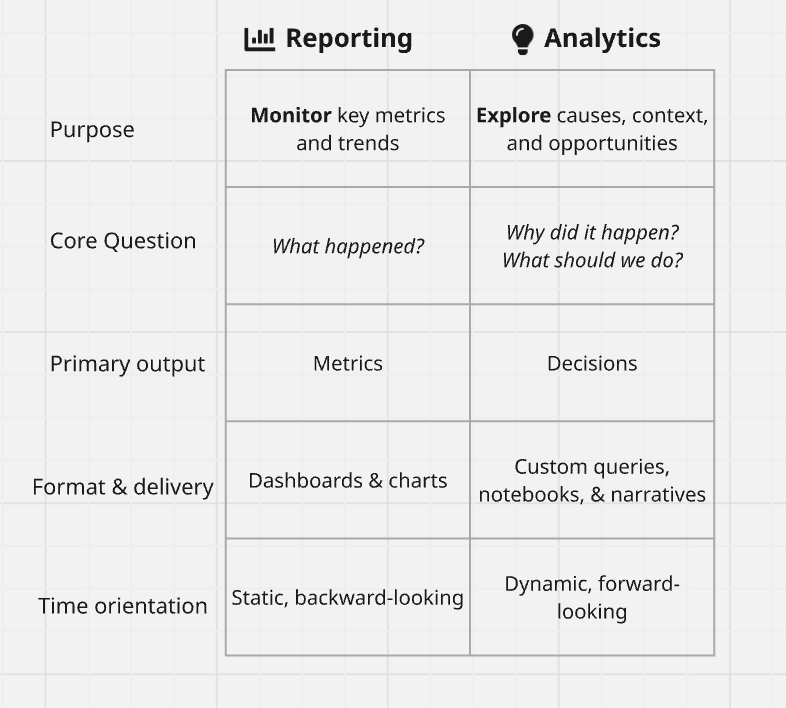
Reporting is about metrics. It records what occurred, based on predefined questions and known unknowns.
Analytics, on the other hand, is about decisions. It starts with curiosity, iterative exploration, and context. It explains the “why” behind the “what” and guides you toward “what next.”
A Real Example
Reporting says: Q2 was $1.2M, down 18% from Q1; website conversion dropped from 3.2% to 2.5%.
Analytics asks: Why did that happen?
- The paid search budget ran out mid-month → high-intent traffic declined.
- New users (from a giveaway campaign) converted at a rate 60% lower than returning users.
- A top-performing SKU went out of stock in April → impacting average order value.
That’s the difference between knowing something’s wrong and knowing what to do about it.
The Hidden Costs of Reporting-First Thinking
Reporting has a place. We need to know the score before we can change the game. But when reporting becomes the end instead of the beginning, progress stalls.
Consequences:
- Decision paralysis: Weekly dashboards no one understands create confusion and inaction.
- Data trust erosion: Duplicated logic and conflicting definitions lead to debating the number instead of its implications.
- Analyst burnout: Data teams become reactive ticket desks instead of strategic thought partners.
- Missed leverage: Optimizing locally instead of strategically means missing cross-functional patterns and leading indicators.
- This isn’t theoretical: it happens every day in organizations with mature tech stacks and capable teams. The issue isn’t people; it’s priorities.
What True Analytics Looks Like
Real analytics doesn’t just live in dashboards; it powers decisions with clarity and confidence. You know it’s working when:
- A product team pivots the roadmap based on behavioral analysis, not opinion.
- A marketing team reallocates budget mid-quarter after spotting a pattern.
- A revenue leader diagnoses churn by slicing across usage, industry and timing.
The CEO asks, “What’s going on here?” and gets an answer in plain English — not SQL.
Analytics shifts the narrative: from artifact to dialogue, from past record to future-shaper.
Final Thought: Reporting Keeps Score. Analytics Helps You Win.
In theory, we have more data at our fingertips than ever. In practice, decision-makers still lack confidence in using it. Why? Because we’ve over-invested in reporting and under-invested in analytics.
It’s time to stop treating dashboards as the finish line. They’re the starting line.
Our goal isn’t just to monitor the past… It’s to shape the future. Not just to count what happened, but to guide what’s next.
That’s why we built Zenlytic, and introduced Zoe, your AI data coworker, to make analytics accessible and help every team win.