

If you run a retail business and struggle to predict what your customers want before they walk through the door, you’re not alone. Traditional retail guesswork makes you leave money on the table and frustrates shoppers who expect personalized experiences.
Predictive analytics transforms raw data into foresight, so you can anticipate demand, optimize inventory, and create experiences that turn browsers into loyal buyers.
In this article, we’ll explore how predictive analytics reshapes retail sales and customer experience through data-driven decisions.
TL;DR – Impact of Predictive Analytics on Retail Sales and Customer Experience
Retailers face a paradox where they have too much data but too few insights.
Predictive analytics helps you forecast customer behavior, optimize inventory, and personalize customer touchpoints across different channels.
Here’s a quick overview of what predictive analytics delivers for retail operations:
- Dynamic pricing
- Inventory optimization
- Targeted promotions
- Churn prevention
- Cross-sell recommendations
- Personalized product suggestions
- Optimized store layouts
- Proactive customer service
- Seamless omnichannel experiences
- Reduced wait times
We’ll discuss these benefits in detail later in the article.

How Predictive Analytics Works in Retail Environments
Predictive analytics uncovers patterns invisible to human analysis.
The technology follows a systematic approach that turns your existing data into a competitive advantage.
Let’s see how the process unfolds in retail settings:
- Collecting and Integrating Data: Your point-of-sale systems, e-commerce platforms, loyalty programs, and supply chain management tools generate massive datasets every day. With data analytics tools, you can put this information into a single view to connect transactions to customer profiles and inventory levels.
- Pattern Recognition Through Machine Learning: Algorithms scan historical data to identify trends that predict future behavior. For example, a customer who buys sneakers is likely to buy athletic apparel within 30 days, and the system flags this opportunity for targeted marketing.
- Real-Time Scoring and Recommendations: Once deployed, predictive models score every customer interaction in real-time. The system determines which complementary products to display and what discount threshold makes people buy.
- Ongoing Learning and Refinement: Models improve as they consume new data, which helps them adapt to shifting consumer preferences and market dynamics. A model that predicted sweater demand two years ago automatically adjusts for current-year fashion trends without manual reconfiguration.
“You are correct: Predictive Analytics does not promise future results; instead, it uses patterns in past and real-time data to figure out probabilities. It’s not so much about predicting the future as it is about giving businesses the tools they need to make better decisions when they don’t know what’s going to happen.” —JellyfishTech
Predictive Analytics Retail Examples
Real retailers are using AI-powered predictive analytics to solve concrete business problems and achieve measurable results.
The examples below show how the technology is changing the retail sector for real companies:
Koio (Italian Footwear Brand)
KOIO, a direct-to-consumer sneaker brand, replaced manual Excel reporting with Zenlytic’s AI-powered analytics.
The head of marketing now saves about 20 hours weekly on report creation while gaining real-time visibility into sales patterns by gender, style, size, and specific SKUs.
This granular product intelligence helped Koio optimize its new female-category offerings, driving revenue growth in a previously underperforming segment.

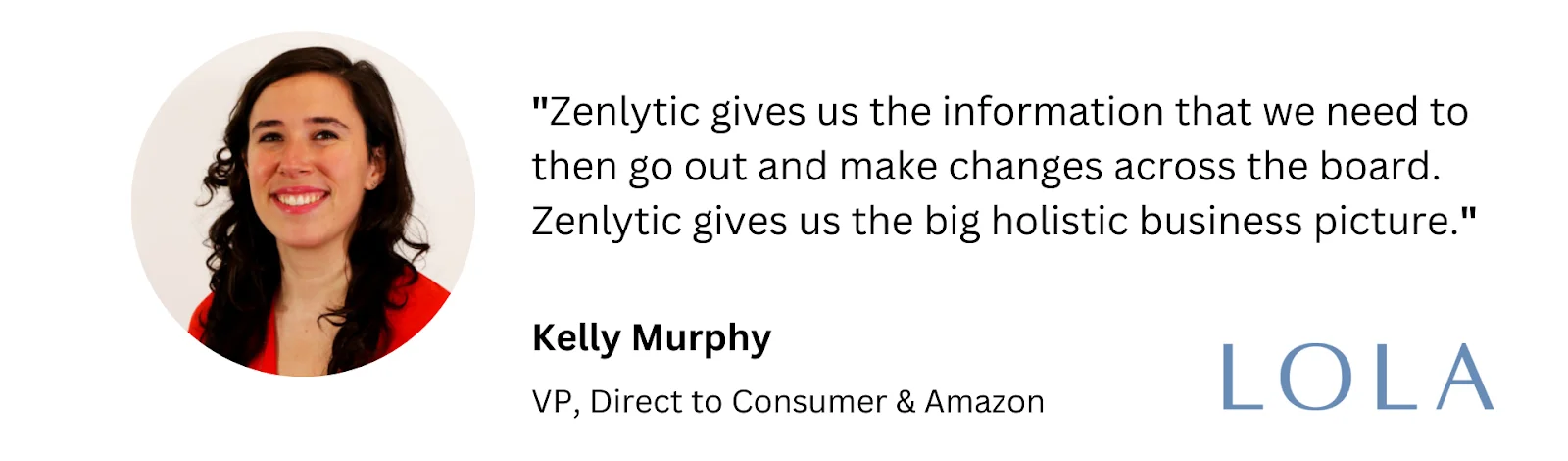
LOLA (Subscription Personal Care Brand)
LOLA, a DTC subscription brand, uses Zenlytic to track comprehensive performance metrics for new product launches and understand behavioral differences between one-time purchasers and subscribers.
The AI data analytics agent, Zoë, enables quick queries without technical expertise, allowing the team to monitor subscription migrations in real time and make faster pivot decisions based on launch performance data.
Zenlytic freed the marketing team from hours spent compiling reports manually, allowing them to focus on optimizing campaigns.
Nike’s Predictive Inventory Management
Nike uses predictive analytics for SKU-level planning across their global supply chain, incorporating historical sales, seasonal trends, social media sentiment, and weather patterns into their forecasting models.
Their Nike Fit app combines computer vision and machine learning to improve sizing accuracy. Real-time inventory tracking across stores and distribution centers cuts forecasting errors and reduces stockouts.
Nike freed up working capital previously tied up in excess inventory while ensuring products remained available during peak demand.
As you’ll notice, all these retailers have something in common. They leverage real-time data and artificial intelligence to make business decisions faster and more accurately than traditional forecasting methods allow.
How Predictive Analytics Improves Retail Sales
A good growth rate in sales comes from many minor optimizations, and predictive analytics automates these improvements across your entire retail operation.
The technology transforms guesswork into precision across pricing, inventory, promotions, and customer retention.
Here’s where predictive analytics drives revenue growth:
1. Dynamic Pricing That Responds to Market Conditions
Predictive models adjust prices in real-time based on competitor pricing, inventory levels, the time until season end, and the price sensitivity of individual customers.
The adjustments maximize revenue per item while maintaining competitive positioning.
2. Inventory Optimization That Eliminates Stockouts
Running out of popular items costs you revenue, while overstocking ties up capital in merchandise that eventually sells at steep discounts.
Predictive analytics forecasts demand at the SKU level for each location, so you stock exactly what customers will buy.
3. Targeted Promotions That Convert Browsers
Generic promotions waste marketing spend on customers who would buy anyway or those who never intended to purchase.
Predictive models identify which customers need an incentive to convert and what discount level triggers purchases.
4. Churn Prevention Before Customers Leave
Predictive analytics spots early warning signs that loyal customers are about to defect to competitors.
When someone who usually shops monthly goes six weeks without a purchase, the system triggers personalized reengagement campaigns to win them back.
5. Cross-Sell and Upsell Recommendations
Predictive models analyze purchase patterns across your entire customer base to identify which product combinations drive the highest lifetime value.
Surfacing these connections can increase basket size at checkout, which increases your revenue.
How Predictive Analytics Enhances Customer Experience
Customer experience separates thriving retailers from those that close locations every year, and predictive analytics personalizes every touchpoint to match individual preferences.
The technology shifts retail from one-size-fits-all approaches to individualized experiences at scale.
Here’s how predictive analytics elevates customer satisfaction:
1. Personalized Product Recommendations
Generic “customers also bought” suggestions feel impersonal and often miss the mark.
Predictive analytics creates individualized recommendation engines that learn from each interaction, surfacing products that align with personal style and budget constraints.
2. Optimized Store Layouts Based on Traffic Patterns
Predictive models analyze foot traffic data to optimize product placement.
They can help you put high-margin impulse items where customers naturally pause, ensuring you position essential goods in strategic places to encourage store traversal.
3. Proactive Customer Service
Predictive analytics goes hand in hand with proactive analytics, helping you identify customers who are likely to need support and offer it to them before they contact you.
For instance, someone who ordered a complex product receives assembly tips automatically, while frequent buyers get priority access to customer service representatives.
4. Seamless Omnichannel Experiences
Customers expect to browse online, buy in-store, and return through any channel without friction.
Predictive analytics connects these touchpoints, so store associates know what customers viewed online and can guide them to relevant products immediately.
5. Reduced Wait Times Through Demand Forecasting
Predictive models forecast traffic patterns by hour and day, allowing you to schedule staff when customers need help most.
You can reduce checkout time for customers, making them more likely to return to your store.
Predictive Analytics Use Cases in the Retail Industry
Beyond the core improvements to sales and customer experience, predictive analytics solves specific operational challenges that retailers face daily. These use cases demonstrate how the technology adapts to different retail scenarios and business models.
Here are the most impactful applications across retail operations:
Optimizing Markdown
Retailers lose billions annually through poorly timed markdowns that either happen too early (leaving money on the table) or too late (resulting in deadstock).
Predictive analytics identifies the optimal timing for markdown and percentage for each product based on inventory levels, seasonality, store-by-store performance, and historical clearance patterns.
“Visual merchandizing/store layout is all well and good to influence purchasing decisions, and you can probably keep track mentally of what’s going on for one or two stores at the time if there is minimal re-merchandizing happening… What is more realistic to analyze would be pricing and, if applicable, promotions (in the form of price reductions).” —discthief
Planning What Products to Sell
Predictive analytics tools can analyze regional buying patterns, demographic data, and competitive positioning to recommend store-specific assortments.
The analysis can help retailers decide which products to sell in each location by balancing local preferences with inventory efficiency.
Workforce Scheduling
Labor costs represent one of your largest expense categories, yet many retailers still schedule staff based on rough estimates.
Predictive analytics forecasts foot traffic, accounting for weather, local events, holidays, and promotional calendars. You schedule precisely the right number of employees when customers need assistance most.
Fraud Detection
Payment fraud costs retailers revenue annually, and traditional rule-based systems generate false positives that frustrate legitimate customers.
Machine learning models analyze transaction patterns in real time to flag suspicious activity with greater accuracy while reducing false positives compared to legacy systems.
Zenlytic: The Analytics Agent Platform for Retail Intelligence
Making sense of retail data shouldn’t require a team of data scientists or weeks of waiting for answers. Modern retailers need insights at the speed of customer decisions.
Zenlytic delivers predictive analytics through Zoë, an AI data analyst that answers business questions in natural language through a conversational data analysis interface.
Retail teams ask questions like “which products are trending this month” or “show me customer segments most likely to churn next quarter,” and Zoë returns accurate answers in seconds, not days.
The results speak for themselves when it comes to saving time and getting accurate answers:
“Zoë replaced hours of manual analysis with instant clarity. Instead of stitching together spreadsheets and reports, we can actually focus on making better decisions.” — Analytics Leader, Retail & Supply Chain
Here’s what sets Zenlytic apart for retail intelligence:
- Advanced Context Management Through the Clarity Engine: Zenlytic’s Clarity Engine combines SQL flexibility with semantic layer governance. This helps Zoë understand retail-specific metrics such as same-store sales growth, inventory turnover, and customer lifetime value without requiring you to define every calculation upfront.
- Full Transparency Through Citations: Every metric Zoë produces includes Citations that show exactly which data sources and calculations generated the results. You see the SQL behind the insights, so you trust the recommendations enough to act on them.
- Consistent Answers With Memories: Retail definitions matter. For example, when you ask about “holiday season performance,” does that mean November through December, or does it include early January? Zenlytic’s Memories feature locks in your business logic, so every team member gets the same answer every time.
- Deep Analysis Beyond Basic Dashboards: Zoë doesn’t just retrieve pre-built reports. She analyzes relationships between inventory levels, promotional effectiveness, and customer behavior patterns to answer complex questions that would take analysts days to research manually.
Common Implementation Challenges and Solutions
Predictive analytics delivers transformative results, but implementing it calls for careful planning to avoid common problems.
You’ll want to understand these challenges upfront to build realistic timelines and secure necessary resources.
Here’s what slows down adoption and how to overcome each obstacle:
- Resistance to New Tools: Most team members who are accustomed to intuition-based decisions often resist data-driven recommendations, especially when predictions contradict conventional wisdom. You can start with pilot projects in departments where staff members are more enthusiastic, document quick wins with concrete metrics, then use their success stories to build broader buy-in.
- Data Quality Issues: Your predictive models are only as good as the data you feed them. Start with a data audit that identifies quality issues before model development begins, then clean the most important data first.
- Integration Complexity: AI agents for predictive data analysis must integrate with your current tech stack. These include your Point-of-Sale systems, inventory management tools, and CRM platforms. Choose platforms with pre-built connectors to your core systems and budget time for integration work upfront rather than treating it as an afterthought.
- Skill Gaps: Most retail teams lack data scientists who can build predictive models. Modern analytics platforms like Zenlytic eliminate this barrier with conversational analytics interfaces that business users operate without coding knowledge. You get sophisticated analytics without hiring specialized talent.
“We needed a solution that let senior business leaders ask complex, data-driven questions without requiring SQL knowledge or report-building skills. After evaluating several GenAI tools, only Zenlytic fully harnessed AI to deliver meaningful, business-ready insights.” — Josh Horton, Director of Data, Analytics & AI, Cox 2M
Frequently Asked Questions (FAQs)
Retailers considering predictive analytics often have practical questions about implementation, costs, and expected results.
Let’s check out a few below:
Can Small Retailers Use Predictive Analytics Effectively?
Yes. Small retailers can leverage predictive analytics through cloud-based platforms with subscription pricing that scales with business size.
These retailers often see faster ROI because they can act on insights immediately without navigating complex corporate approval processes. Focus on one high-impact use case first, like inventory optimization for your top 20% of SKUs.
How Long Does It Take to See ROI From Predictive Analytics in Retail?
Most retailers generally see measurable ROI within three to six months of implementing predictive analytics.
Quick wins come from demand forecasting that reduces overstock and prevents stockouts, typically delivering reasonable inventory cost savings in the first quarter.
The best approach is to start with clean, accessible data and clear success metrics.
What KPIs Should You Track After Implementing Predictive Analytics?
You should track forecast accuracy as your primary technical metric, measuring how closely predicted demand matches actual sales.
Business impact metrics include inventory turnover rate, gross margin percentage, conversion rate by channel, and customer lifetime value.
Compare these KPIs to your baseline before implementation and segment results by customer cohort or product category.
Conclusion
As a retail brand, predictive analytics can help you move from solving problems reactively to creating opportunities proactively.
You can forecast demand with more precision, personalize experiences at scale, and make decisions backed by data rather than intuition.
Zenlytic’s analytics agent cuts through data complexity with explainable AI that business teams trust.
You don’t need SQL knowledge or wait weeks for reports. You just ask questions and get instant answers that turn insights into action.
Book your Zenlytic demo today and discover how retail teams leverage predictive analytics to improve sales and customer experience at scale.