

Ever wondered why a forecast missed the mark or why a promising pipeline failed to convert into revenue? Sales teams generate more data than ever, but turning that information into clear answers remains a challenge.
Sales analytics software helps revenue teams track performance, uncover trends, improve forecasting, and make smarter decisions.
In this guide, we’ll cover how sales analytics works, the different types of analytics platforms, and five of the best sales analytics software solutions available today.
TL;DR: 5 Best Sales Analytics Software Compared
Short on time? Here’s a quick look at the platforms covered in this guide before we dive into the details.
| Platform | Best For |
| Zenlytic | Mid-market and enterprise teams that need trusted, AI-powered analytics and governed metrics |
| ThoughtSpot | Organizations looking for search-driven analytics and self-service data exploration |
| Clari | Revenue teams focused on forecasting accuracy and pipeline visibility |
| Zoho Analytics | Small and mid-sized businesses that need affordable reporting and sales analytics |
| HubSpot Sales Hub | Growing sales teams looking for CRM, automation, and analytics in a single platform |
What is Sales Analytics Software and How It Works
Sales analytics software helps your revenue team understand performance, forecast future outcomes, and find new opportunities for growth. It brings together data from your customer relationship management (CRM) systems, enterprise resource planning (ERP) platforms, sales engagement tools, and customer interactions to give you a unified view of your entire sales process.
While capabilities vary across different sales analytics platforms, most sales analytics solutions follow a similar process:
- Collect data from CRM systems, revenue platforms, ERP software, and customer touchpoints.
- Standardize key performance metrics so your sales, finance, and operations teams all work from the same consistent definitions.
- Assess performance across pipeline activity, conversion rates, sales cycles, and revenue trends.
- Generate forecasts and insights that help your team prioritize opportunities and make better decisions.

Benefits of Using a Sales Analytics Solution
Most sales teams already have access to large amounts of data. CRM records, call activity, pipeline reports, customer interactions, and revenue metrics are often spread across multiple systems.
Sales analytics software brings that information together and helps teams turn it into decisions they can act on. Below are some of the most valuable ways sales analytics platforms help revenue teams improve performance.
- More Accurate Revenue Forecasts: The best platform for sales data analytics uses your historical performance and pipeline signals to improve your forecast accuracy. This helps you spot risks early, ensuring that even small adjustments create a massive business impact.
- Shorter Sales Cycles and Higher Win Rates: When you have clear visibility into your pipeline, you can easily spot stalled deals and focus your energy on the accounts most likely to close. Teams using sales analytics regularly see much faster deal cycles and stronger conversion rates.
- Stronger Revenue Growth: Data-driven organizations consistently outperform their peers. McKinsey found they are 23 times more effective at customer acquisition, 6 times more likely to retain customers, and 19 times more profitable.
- Better Resource Allocation: Smart sales data software helps you identify bottlenecked workflows, prioritize high-impact deals, and deploy your team where they matter most. In fact, companies with advanced data capabilities outpace industry averages by as much as 30%.
Types of Sales Analytics Tools
Once you experience those benefits, choose your sales analytics platforms based on how deeply you need to analyze your data. As your team becomes more data-driven, you will naturally progress through these four tool types to answer your biggest growth questions.
- Descriptive Analytics (What happened?): Teams use it to track revenue, monitor pipeline performance, measure win rates, and understand sales activity across a given period.
- Diagnostic Analytics (Why did it happen?): It helps your team investigate lost deals, pinpoint pipeline bottlenecks, compare individual rep performance, and understand the real drivers behind your revenue trends.
- Predictive Analytics (What’s likely to happen next?): You can use predictive analytics for reliable sales forecasting, accurate lead scoring, churn prediction, and overall pipeline health analysis.
- Prescriptive Analytics (What should we do next?): Your leadership team can use these solutions to prioritize hot opportunities, optimize your pricing strategies, allocate resources, and focus your reps on the exact actions most likely to drive results.

Top-Rated Sales Enablement Analytics Platforms
The sales analytics market includes everything from CRM-native reporting tools to AI-powered analytics platforms built for forecasting, revenue intelligence, and decision support.
Here are five of the best sales analytics platforms to consider.
1. Zenlytic
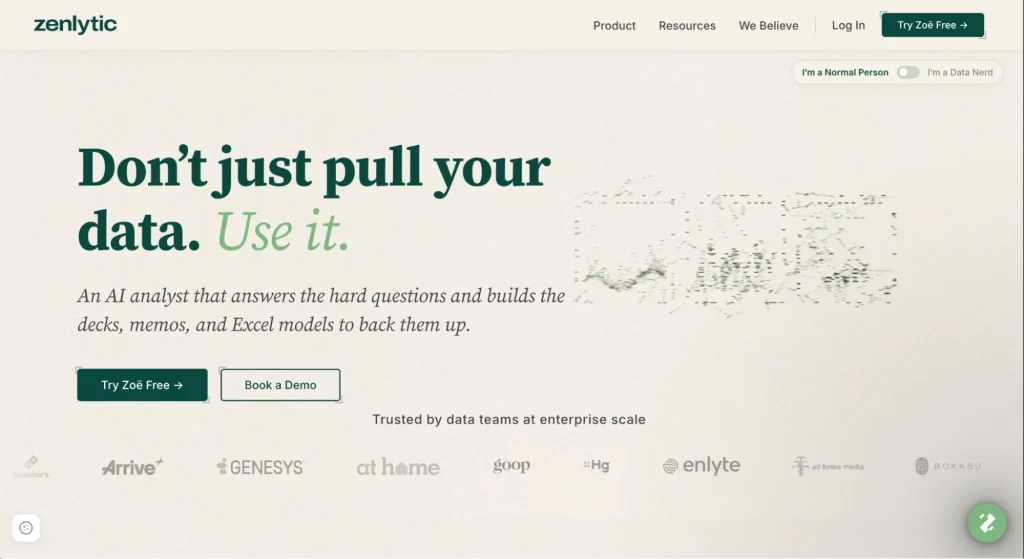
Zenlytic is an AI analytics platform designed to help organizations answer business questions, explore data, and make decisions with greater confidence. Built on a governed semantic layer, the platform combines natural language analytics, explainability, and AI-powered investigation to help teams move from reporting to actionable insights.
Its AI data analyst, Zoë, can answer complex questions, explain how answers were generated, and support follow-up analysis without requiring users to build dashboards or write SQL.
Key Features:
- Zenlytic’s Clarity Engine for explainable answers, governed metrics, and flexible AI-driven analysis.
- Self-Learning capabilities that build, maintain, and refine business context over time.
- Model Context Protocol (MCP) integrations that connect warehouse data with tools like Salesforce, Slack, Jira, and Google Drive.
- Artifacts for creating live reports, presentations, financial models, and data applications.
Ask Zoë to explore your sales data, uncover revenue opportunities, and answer the questions dashboards leave behind.
2. ThoughSpot

ThoughtSpot is a search-driven analytics platform that helps your sales team explore data through natural language queries. It focuses entirely on self-service analytics, which means your business users can uncover insights on their own without constantly relying on technical teams.
3. Clari
Clari is a specialized revenue intelligence platform built to sharpen your forecasting accuracy and pipeline visibility. It pulls together your CRM and revenue data so you can quickly spot hidden risks, track deal progression, and bring predictability to your revenue operations.
4. Zoho Analytics

Zoho Analytics provides robust reporting and AI business intelligence capabilities to help you analyze your CRM and operational data. If you want to get started quickly, it offers a massive library of pre-built dashboards and reporting templates.
5. HubSpot Sales Hub

HubSpot Sales Hub combines CRM, sales engagement, automation, and reporting into a single, unified platform. It is an ideal option if you want to manage both your daily sales execution and your performance analytics inside one system.
Key Features to Look for in a Sales Analytics Software
After comparing different sales analytics platforms, the next step is understanding which capabilities will have the biggest impact on your team. When choosing a sales analytics platform for your business, prioritize these key features:
- Seamless Data Integrations: Strong integrations give you a complete, real-time view of your performance without forcing you to manually consolidate spreadsheet data.
- Custom Dashboards and Reporting: Look for flexible dashboards that let you easily monitor pipeline health, revenue trends, rep performance, and your key performance indicators (KPIs) at a glance.
- Automation and Alerts: Automated reporting, instant notifications, and anomaly detection ensure you always know what is happening in your pipeline without spending hours building manual reports.
How to Measure ROI of a Sales Analytics Platform
The value of sales analytics extends far beyond basic reporting. The strongest sales analytics platforms sharpen your forecasting, boost productivity, and shorten your sales cycles.
When evaluating your return on investment, focus directly on the key business outcomes that drive your revenue. These include:
- Forecast Accuracy: Accurate forecasts improve your planning across hiring, budgeting, and resource allocation. When you use reliable sales analytics solutions, even tiny adjustments to your forecast create a massive financial impact.
- Pipeline Velocity: Monitor how quickly opportunities move through your funnel. When you use sales data software to clear out bottlenecks, you accelerate your deal progression and realize revenue much faster.
- Win Rates and Deal Size: Evaluate whether better visibility helps your team close more deals or increase your average contract value. Combining deeper insights with B2B sales data analytics solutions makes it much easier for your reps to defend your pricing and land larger accounts.
How to Choose the Right Sales Analytics Tool
Almost all sales analytics platforms promise better visibility, accurate forecasting, and improved decision-making. But the real challenge is finding the right analytics tool that caters to your team’s goals, daily workflows, and existing data environment.
As you evaluate your options, ask yourself these important questions.
- How mature is your data environment? Teams working primarily from CRM data may only need reporting and forecasting capabilities. Organizations combining CRM, ERP, marketing, and warehouse data often benefit from platforms built for more complex analytics.
- Who needs answers from the platform? Some tools are built strictly for data analysts, while others support sales leaders, RevOps teams, and everyday business users. Consider exactly how many people will rely on the software and how technical they are, so you can choose an accessible sales analytics platform option.
- Can you trust the answers it provides? Look for sales data software with strong data governance and semantic modeling to ensure your sales, finance, and operations teams always work from the exact same business definitions.

Frequently Asked Questions (FAQs)
Here are answers to some common questions buyers have when evaluating sales analytics software.
Is Sales Analytics Software the Same as a CRM?
No. A CRM stores and manages customer and deal information, while sales analytics software helps teams analyze that data to uncover trends, improve forecasting, and support decision-making.
What Metrics Should Sales Analytics Reporting Include?
The most important metrics depend entirely on your unique business model. However, most teams use sales analytics to track pipeline value, win rates, sales cycle length, average deal size, quota attainment, forecast accuracy, and overall revenue growth.
How Often Should a Sales Analytics Dashboard Update Data?
Most modern sales data software supports near-real-time data syncing or scheduled updates throughout the day. Your ideal frequency depends on how quickly your sales environment moves and how often your leadership team makes data-driven decisions.
How Long Does It Take to Implement Sales Analytics Software?
The software implementation time depends on your platform choice and data complexity. You can deploy some cloud-based sales analytics solutions in just a few days, while complex enterprise implementations that combine multiple systems and custom reporting can take several weeks.
How Can Online Businesses Use Data Analytics to Increase Sales?
Online businesses can use the best data analytics platforms to identify their highest-converting channels, track buyer behavior, and optimize pricing. These insights help you automatically surface your most profitable product segments so you can deploy your marketing budget where it drives the highest return.
Conclusion
The best sales analytics software depends on your team’s goals, data maturity, and reporting needs. Some platforms focus on forecasting, while others specialize in revenue intelligence, business intelligence, or AI-powered analytics.
We built Zenlytic, our AI analytics platform, to help teams move from questions to trusted answers faster. Zoë, our AI data analyst, combines natural language analytics, Zenlytic’s Clarity Engine, Self-Learning capabilities, and Artifacts to deliver explainable insights, consistent metrics, and live reports that stay connected to your data.